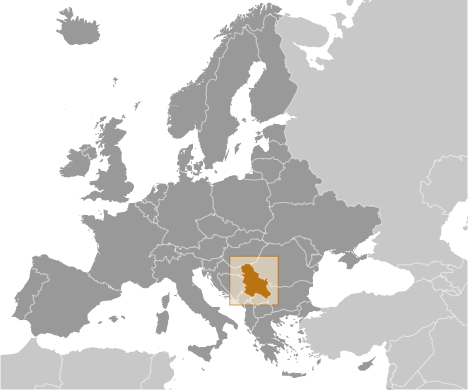
Serbia

What's New

Read more news….


freedom of information

Text from the freedominfo.org Global Survey: Freedom of Information and Access to Government Records Around the World, by David Banisar (updated July 2006)

Article 10 of the Constitution of Serbia states:

The work of State agencies shall be open to the public. The publicity of work of the State agencies may be restricted or precluded only in cases provided by law.(1)

The Law on Free Access to Information of Public Importance was adopted on 5 November 2004 and went into effect on 13 November 2004.(2)

The law allows any person the right to demand information from public authorities including state bodies, organizations vested with public authority and legal persons funded wholly or predominately by a state body. There is a public interest for information relating to a threat to public health and the environment and a presumed interest to all other information unless the public authority can prove otherwise. The request should be in writing but if it is made orally, the public authority should record it and treat it in the same way as a written request. Public authorities are required to respond in 15 days except in cases where there is a threat to the person’s life or freedom, protection of the public health or environment, in which case the request must be responded to in 48 hours. The deadline can be extended to a total of 40 days in cases where the authority has a justified reason to not respond in the 15 day deadline. Authorities cannot give preference to a single journalist or media outlet when several have applied for the information. It does not apply to areas under federal jurisdiction such as foreign affairs.

Access to documents is free. Fees for copies of documents can be imposed and are waived for journalists, NGOs focusing on human rights, and those asking for information relating to a threat to their persons or the public.

There are mandatory exemptions for information if its release would: risk the life, health, safety or another vital interest of a person; imperil, obstruct or impede in the criminal process or other legal proceedings; seriously imperil national defense, national and public safety or international relations; substantially undermine economic processes or significantly impede economic interests; or make available information protected by law that is protected as a state, official, business or other secret if its disclosure could seriously prejudice the interests and outweigh the interest in access to information. Access to information is also limited if it would violate the right to privacy or reputation unless the person consents, it relates to a person, phenomenon, or even especially done by a public official relating to their duties, or the person has given rise to the request by their behaviour.

An appeal can be made to the Commission for Information of Public Importance.(3) The Commission is an autonomous and independent public body. The Commissioner can hear cases relating to denial of access to information, delays, excessive fees, and refusal to provide the information in the form or language request by the applicant. His decisions are binding on public authorities. If the body fails to release the information, the Commissioner can ask the government to enforce the decision. The Commissioner expressed concern in March 2006 that there are a number of decisions that have not been acted on by the bodies and that the Ministry of Culture did not have any ability to enforce sanctions for non-compliance. The Ministry of Culture informed the Commissioner that an amendment to transfer that authority to the Ministry of State Administration was being developed.

The requestor can appeal decisions of the Commissioner to the courts. Appeals of denials relating to the National Assembly, President, Cabinet, the Supreme Court, the Constitutional Court and the Public Prosecutor are not allowed to be heard by the Commissioner because they have a higher constitutional standing than the Commissioner. Appeals in those cases can only be made directly to an administrative court and the court can only review the reasonableness of the procedure rather than the merits.

The Commissioner also monitors the implementation by public authorities, prepares or proposes changes to regulations on implementation, trains employees, considers complaints, educates the public, and publishes a public manual on how to use the law. The Commissioner was appointed in December 2004 but there have been problems with adequate funding for the office. Initially, much of the promotion work was funded by the Fund for an Open Society Institute (FOSS) and the OSCE Mission in Serbia and Montenegro. The Commission received 693 cases from July 2005 and February 2006. It resolved 443 cases in that time, mostly relating to non-responses by public bodies. It found for the requestor in all but 14 cases.

Public authorities must appoint an authorized official to receive requests and monitor and promote implementation. They must publish an annual directory describing its powers, duties and organization, its budget, the types of services it offers, the names of its heads and their powers and duties, the types of information it holds, and procedures for submitting requests. They must also train their staff on the law and publish an annual report to the Commissioner on the activities relating to the Act. The Ministry of Culture is in charge of implementation and coordination of the law.

Public authorities can be held liable for damages if they prevent a media outlet from publishing information by withholding it without justification or by giving preference to another journalist or media outlet. The authorized official can be fined up to 50,000 dinars (500 euros) for violating the provisions of the law, including failing to submit the annual report.

Reviews of implementation have found many problems. The Commissioner expressed “serious concerns” with the implementation so far, stating in his March 2006 report that “willingness of state agencies to allow access to all information on their work […] is still on a low level.”(4) He expressed concern about the high level of silent refusals by public bodies, the lack of justification for refusing information, and denials based on requests from other bodies. He found that less than ten percent of denials were justified. The Commissioner also noted that most state authorities “had done almost nothing or completely little to educate their personnel in implementation of the law”, not produced the required information booklets, set up web sites, and many never produced or were late with their annual reports. Of the bodies that did submit reports, there were a total of over 2,000 requests for the period. A review of five municipalities by CeSID and the Commission in 2006 found that bodies have not adequately provided enough training and resources for public employees and that there is a low level of awareness of the law by the population (20 percent).(5)

The 1998 FRY Law on Protection of Personal Data gives citizens a right to access and correct personal information held by public and private bodies.(6) Citizens can sue in court if the law is violated. The law is not widely known and there are currently efforts to replace it. The government is currently developing a new law to replace it.

There is no law setting out procedures on the protection of state secrets. In May 2001, the government issued two decrees allowing for citizen to have limited access to their files created by the State Security Service under Milosevic. Citizens were allowed to look at summaries but could not copy them or take notes. The Lawyers Committee for Human Rights (YUCOM) asked the Constitutional Court to review the legality of the decree. The Court ruled in 2003 that it was illegal and it was withdrawn in June 2003. The Parliament adopted a Lustration Law in May 2003.(7) The Criminal Code prohibits the disclosure of state secrets. In 2004, the government raided the offices of the Helsinki Committee for Human Rights and seized a book based on the state secrets claims.

Serbia has not signed the Aarhus Convention.


NOTES

  1. Constitution of Serbia, 1990. http://www.arhiva.serbia.sr.gov.yu/cms/view.php?id=1011
  2. Law on Free Access to Information of Public Importance. http://www.poverenik.org.yu/Dokumentacija/eng_23_ldok.pdf
  3. Homepage: http://www.poverenik.org.yu/default_eng.asp
  4. Commissioner for Information of Public Importance, Report of the Implementation of the Law of Free Access to Information of Public Importance, March 2006.
  5. Implementation of Free Access to Information Law Lacking, Oneworld.net, 12 April 2006.
  6. Law on Protection of Personal Data, 12 May 1998. http://www.gov.yu/informatics/documents/LawOnProtection.htm
  7. Accountability for Human Rights Violations Act, Official Gazette of the RS” No. 58/2003. http://www.lustration.net/human_rights.pdf

Be Sociable, Share!

News Archive

  • 22 March 2006

    EBRD Seeks Comment on Draft of New Disclosure Policy

    At the London-based European Bank for Reconstruction and Development, the board recently released a proposal to modify its disclosure policies, with comments due April 14. The EBRD included in its announcement a number of new provisions.
    First, two new categories…

    Be Sociable, Share!
  • 5 November 2004

    Serbian Parliament Adopts Access Law

    The Serbian National Assembly, in its Plenary Session on November 2, 2004, adopted the Law on Free Access to Information of Public Importance. The Law will enter into force eight days after its publication in the Official Gazette of Serbia.…

    Be Sociable, Share!
  • 24 February 2004

    Parliamentarians Flex Growing Organization, Make Request of Bank

    The chairman of an international group of parliamentarians has asked the World Bank to help assure a larger role for legislatures in setting the poverty-fighting strategies within their countries.
    The request marks one of the first times the parliamentarians have…

    Be Sociable, Share!

links

LEGAL DOCUMENTS

Serbian Law on Free Access to Information of Public Importance

ORGANIZATIONS

Helsinki Committee for Human Rights in Serbia

Lawyers' Committee for Human Rights - Serbia

Transparency Serbia

Fund for an Open Society in Serbia

OTHER RESOURCES

OSCE Mission to Serbia and Montenegro, Guidebook on 2004 Law on Free Access to Information of Public Importance
Abstract [English]
Full text [Serbian]

Art. 19, Serbia and Montenegro: UN Report Urges Greater Respect for Freedom of Expression (13 August 2004)

Council of Europe Comments on the Serbian FOI Law, Round Table - Free Access to Information, A Constitutional Right of Citizens and Possibility Given by the Law, Belgrade (8 July 2004)

Open Society Justice Initiative, Comments on Serbian Draft Law on Access to Information


measuring openness

Freedom House, Freedom in the World, 2009
(On scale of 1-7, with 1 representing the highest level of freedom and 7, the lowest)

Political Rights: 3
Civil Liberties: 2
Status: Free

Center for Public Integrity, Global Integrity Report, 2009
Civil Society, Public Information and Media (rating 1-100):

76 (Moderate)

World Bank, Governance Matters, 2008
(Percentile rank - indicates rank of country among all countries in the world. 0 corresponds to lowest rank and 100 corresponds to highest rank.)

1) Voice and Accountability: 54.8
2) Political Instability and Violence: 28.2
3) Government Effectiveness: 47.9
4) Regulatory Quality: 47.3
5) Rule of Law: 41.1
6) Control of Corruption: 53.1

Transparency International, Corruption Perceptions Index, 2009
(Relates to perceptions of the degree of corruption as seen by business people and country analysts and ranges between 10 - highly clean and 0 - highly corrupt.)

CPI Score: 3.5