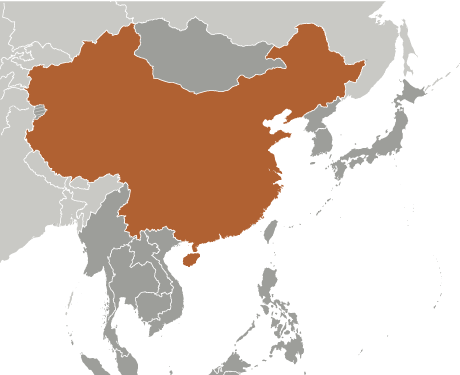
China

What's New

  • 14 May 2012

    Chinese Budget Disclosures Still Considered Inadequate

    China is disclosing more information about its budget, but “the data being released is still too vague to satisfy the taxpayers’ demands,” according to a May 14 article in the China Daily by  Zhao Yinan.
    “So far, 92 out of…

    Be Sociable, Share!
  • 14 October 2011

    Chinese Agencies Rank Poorly in Annual Transparency Study

    Thirty-five out of China’s 43 federal departments get failing grades on transparency, according to the 2010 China Administrative Transparency Report by the OGI Watch Alliance Project.
    “The institution that did the worst was the Ministry of Supervision, the very ministry…

    Be Sociable, Share!


Chronology of Open Government Information (OGI) in China

(Prepared by Freedominfo.org contributor Jamie Horsley, Deputy Director of the China Law Center, Yale University, Senior Research Scholar and Lecturer in Law, Yale Law School)

March 1988 The Second Plenum of the 13th Central Committee of the Communist Party of China called for openness of work systems as an important component of honest government, and approves experiments in open government affairs

September 1997 General Secretary and President Jiang Zemin calls for “open government affairs” in his report to the 15th National Communist Party Congress

November 1998 The Organic Law of the People’s Republic of China on Villagers Committees” institutionalizes village-level self-governance and the “open village affairs” system, especially for fiscal transparency

December 2000 “Notice of the General Offices of the Central Committee of the Communist Party of China and the State Council on Comprehensive Implementation of an Open Government Affairs System in Organs of Political Power at the Town and Township Level Throughout the Country” called for promoting “open government affairs” at the town and township level, and for implementation of “open government affairs” at the county (city) level and above

December 2001 China joins the World Trade Organization and signs on to certain international transparency commitments

November 2002 Guangzhou City in Guangdong Province adopts China’s first local OGI Provisions, effective January 1, 2003, which established a clear presumption of disclosure and for the first time in Chinese history require government organs to proactively disseminate government information and gives “natural persons” the right to request information from the Guangzhou government

January 2003 Shanghai Municipality adopts China’s first provincial-level OGI Provisions, effective May 1, 2004, establishing a comprehensive structure for implementing and reporting on the OGI system

March 2004 China’s State Council issues the “Outline on Implementing the Comprehensive Promotion of Administration in Accordance with the Law,” which sets administrative transparency and promoting OGI as nationwide governmental objectives

March 24, 2005 The “Opinions of the General Offices of the Central Committee of the Communist Party of China and the State Council on Further Promoting Open Government Affairs” articulated Party and central government policy to encourage greater administrative transparency and called for formulating national OGI Regulations

January 2007 China’s State Council adopts the Regulations of the People’s Republic of China,” nationwide administrative measures that were published April 2007 and called for institutionalizing information disclosure systems throughout the government at all levels down to the town and township

August 4, 2007 The “Notice of the General Office of the State Council on Preparing Well for Implementing the Regulations of the People’s Republic of China on Open Government Information” set timelines for government organs to prepare required catalogues of and guides to requesting government information

April 29, 2008 The “Opinions of the General Office of the State Council on Various Issues of Implementing the Open Government Information Regulations of the People’s Republic of China” provided some useful guidance including that classified information can be redacted to permit disclosure of at least portions of the record, but also specified that, if requested information does not relate to the requester’s “special needs” as mentioned in Article 13 of the OGI Regulations, the government organ may decline to release the information.

May 1, 2008 The OGI Regulations take effect on International Labor Day holiday

May 5, 2008 First lawsuit under the OGI Regulations is filed by five retired workers in Rucheng County, Hunan province, seeking to make public an investigative report contracted by the county government concerning the reorganization of the workers’ former government-owned employer

May 12, 2008 Chinese government handles reporting on and response to massive earthquake in Wenchuan, Sichuan province with unprecedented initial transparency linked to advent of the OGI Regulations

October 7, 2008 First reported court decision finding in favor of a plaintiff requester, who sued the Huangzhou District Transportation Bureau in Huangqu City, Hubei province, over its failure to respond to a request for information concerning motorcycle regulations

January 12, 2010 The “Opinions of the General Office of the State Council on Improving the Work of Disclosing Government Information Upon Request” clarify the scope of “government information” and restrictions on the right to request information, and calls for more government efforts proactively to disseminate information

March, 2010 China’s central and local governments issue budgets with greater levels of detail.
Be Sociable, Share!

News Archive

  • 17 August 2011

    China to Allow Appeals Over Failure to Provide Information

    Chinese citizens will be able to sue the central government and local governments if their requests for information are denied according to a judicial explanation (in Chinese) from China’s Supreme People’s Court, according to a report from China’s official news agency,…

    Be Sociable, Share!
  • 4 August 2011

    China Restates Openness Policy in New Guidance

    The Chinese government Aug. 2 urged government officials to be more open, a development greeted both with hope and cynicism.
    The new statement does not create any new legal requirements for transparency but was viewed by some as a significant…

    Be Sociable, Share!
  • 29 July 2011

    Chinese Agencies Disclose Spending on Travel

    Chinese government departments have largely complied with a requirement to disclose how much was spent on overseas trips, receptions and vehicles in 2010, according to reports in the Chinese state and commercial media.
    Despite a deadline of June 30 to…

    Be Sociable, Share!
  • 24 May 2011

    Papers Probe Drivers of Transparency in China

    Emerging transparency in China and what explains it was the topic of two papers presented at The First Global Conference on Transparency Research held May 19-20 at Rutgers University-Newark, N.J. (See overall report in FreedomInfo.org.)
    In “the first empirical study…

    Be Sociable, Share!
  • 17 December 2010

    Report Examines Access to Chinese Environmental Data

    China has improved access to some environmental information, but much data on pollution and on the activities is still hard to obtain, according to a new report.
    ARTICLE 19 and the Centre for Legal Assistance to Pollution Victims (CLAPV) at…

    Be Sociable, Share!
  • 8 October 2010

    Report Scores Openness of Chinese Cities, Provinces

    A detailed new report is critical of the openness of  Chinese cities and provincial governments, although the principal author says improvement is evident since last year.
    “More than half of China’s city and provincial governments surveyed have failed open-information requirements, while…

    Be Sociable, Share!
  • 17 September 2010

    FOI Notes: Chinese Cities; FOI for the Media?, Grants

    FOI Request for Rupert Murdoch? British Member of Parliament Dennis MacShane on Sept. 7 suggested that the UK FOIA should be extended to cover not just public authorities but also private media organizations and  bodies which receive state funding, according to…

    Be Sociable, Share!
  • 29 July 2010

    China Agrees to Release IMF Article IV Report

    China has permitted disclosure of the so-called Article IV “staff report” prepared by the International Monetary Fund.
    Last year, China declined to allow release  of the 2009 staff report,  This was a change, because China had permitted release of the 2006 report.…

    Be Sociable, Share!
  • 16 July 2010

    New Regulation Requires More Disclosures by Chinese Officials

    Top Chinese officials will be required to disclose more about their assets under a regulation that became effective July 11, according to Chinese media, but critics say the rules contain loopholes.
    “The regulation adds six more items to the list…

    Be Sociable, Share!
  • 23 April 2010

    Update on China’s Open Government Information Regulations: Surprising Public Demand Yielding Some Positive Results

    By Jamie P. Horsley
    The China Law Center, Yale Law School
    It has been nearly two years since China’s first access to information statute took effect on May 1, 2008. Reviews of how the national Regulations on Open Government Information…

    Be Sociable, Share!
  • 9 January 2010

    IMF Barely Modifies Disclosure Policy

    After an opaque review process, the International Monetary Fund January 8 announced modest changes to its disclosure policy, but retained the major impediment to disclosure, allowing governments to prevent release of documents pertaining to their countries.
    This power prevents the…

    Be Sociable, Share!
  • 16 November 2009

    In Shanghai, President Obama Recognizes Access to Information as Universal Right

    by Yvette M. Chin
    Shanghai, China — On his first trip to Asia, President Obama made unequivocal statements about access to information as a universal human right at a rare town-hall style meeting of university students November 16. Over 2 years…

    Be Sociable, Share!
  • 12 October 2009

    US Treasury Secretary Urges More Transparency at IMF, Advocates Release of All Article IV Reports

    US Treasury Secretary Timothy F. Geithner, speaking October 4 in Istanbul at the International Monetary and Financial Committee (IMFC) meeting, called for more transparency at the International Monetary Fund.
    Geithner said, “Moreover, greater transparency is critical to underpin the credibility…

    Be Sociable, Share!
  • 28 September 2008

    International Right to Know Day 2008: Global Phenomenon Now Includes More Than 80 Countries

    Washington, D.C., September 28, 2008 – Today’s celebration of International Right-to-Know Day marks a new watershed in the global reach of freedom of information laws – now on the books in more than 80 countries – and features celebrations in…

    Be Sociable, Share!
  • 9 May 2007

    China Adopts First Nationwide Open Government Information Regulations

    By Jamie P. Horsley
    The Regulations of the People’s Republic of China on Open Government Information (OGI Regulations) published on April 24, 2007, and effective one year later on May 1, 2008, mark a turning point away from the deeply…

    Be Sociable, Share!
  • 28 September 2005

    International Right to Know Day 2005

    Since 2002, freedom of information advocates around the world have been working together to promote the right of access to information for all people and recognize the benefits of transparent and accountable governments. We use this day as a way…

    Be Sociable, Share!
  • 20 April 2004

    Shanghai Advances the Cause of Open Government Information in China

    While the Chinese State Council mulls over a draft of China’s first freedom of information legislation, the bustling metropolis of Shanghai, home to some 16 million people, adopted China’s first provincial-level open information legislation on January 20, 2004. The Provisions…

    Be Sociable, Share!
  • 11 October 2003

    “The Right to Know is Gaining around the World”

    by Thomas Blanton
    The International Herald Tribune, October 11, 2003, p. 6

    Last month (September 23, 2003), Armenia became the 51st country in the world to guarantee its citizens the right to know what their government is up to. Armenia’s…

    Be Sociable, Share!
  • 14 July 2003

    China’s Pioneering Foray Into Open Government: A Tale of Two Cities

    By Jamie P. Horsley
    Guangzhou Municipal Provisions on Open Government Information
    (Decree No. 8 of the Guangzhou Municipal People’s Government
    dated November 6, 2002) (PDF – 158 KB)
    China’s initial reticence in sharing information about the severe acute respiratory syndrome…

    Be Sociable, Share!
  • 1 June 2002

    World Bank Begins Pilot Programs on Disclosure

    Some 20 countries are about to embark on pilot programs with the World Bank in which they will disclose and disseminate more information than they have in the past – that is, more than what Bank policy currently requires.
    The…

    Be Sociable, Share!

links

LEGAL DOCUMENTS

Regulations of the People’s Republic of China on Open Government Information, April 5, 2007, effective May 1, 2008 (Chinese) (English)

REPORTS

English translation of the summary of Professor Wang Xixin’s China’s Administrative Transparency Report for 2009.

ORGANIZATIONS

General:

Center for Public Participation Studies and Supports 公众参与网, Peking University Law School,  (in Chinese)

China Transparency 透明中国()

The China Law Center, Yale University

Environmental 环境:

Institute for Public and Environmental Affairs 公众与环境研究中心

Natural Resources Defense Council 环境法公众研究网

Center for Legal Assistance to Pollution Victims 中国政法大学环境资源法研究和服务中心


Contributors


Jamie Horsley

Deputy Director of the China Law Center, Yale University

Senior Research Scholar and Lecturer in Law, Yale Law School

Li Yuanyaun

Deputy Director of Center for Public Participation Studies and Supports


measuring openness

Freedom House, Freedom in the World, 2010
(On scale of 1-7, with 1 representing the highest level of freedom and 7, the lowest)

Political Rights: 7
Civil Liberties: 6
Status: Not Free

Global Integrity Report, 2009
Civil Society, Public Information and Media (rating 1-100):

60 (Weak)

World Bank, Governance Matters, 2008
(Percentile rank - indicates rank of country among all countries in the world. 0 corresponds to lowest rank and 100 corresponds to highest rank.)

1) Voice and Accountability: 5.8
2) Political Instability and Violence: 33.5
3) Government Effectiveness: 63.5
4) Regulatory Quality: 46.4
5) Rule of Law: 45.0
6) Control of Corruption: 541.1

Transparency International, Corruption Perceptions Index, 2009
 (Relates to perceptions of the degree of corruption as seen by business people and country analysts and ranges between 10 - highly clean and 0 - highly corrupt.)

CPI Score: 3.6