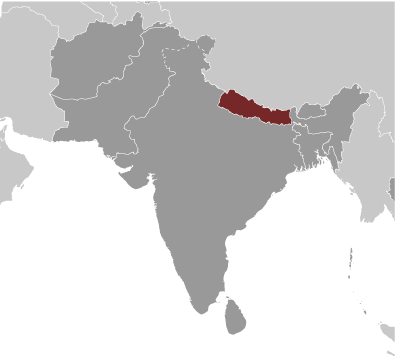
Nepal
What's New
-
19 May 2016
The National Information Commission has ordered the government to provide access to Singha Durbar, the government secretariat complex, for persons seeking to exercise their rights under the Right to Information Act. The commission issued the order in response to an application filed the Chairman of the Freedom Forum Taranath Dahal and several hundred youths associated […]
-
23 March 2016
Representatives from five South Asia countries held a regional conference on right to information on March 16-17, stressing the need to encourage greater use of RTI laws, according to an article in The Daily Times and another in The Tribune. Delegates from Pakistan, India, Sri Lanka, Bangladesh and Nepal met at a conference sponsored by […]
Freedom of Information Overview
Freedom of information is lately recognized as citizen’s right as compared to other fundamental rights in Nepal. It has been around two decades that the state acknowledged people’s access to information as fundamental right with the adoption of the 1990 constitution. The Right to Information (RTI), despite being guaranteed since 1990, was only given effect in July 2007 with the adoption of the RTI Act 2007 in Nepal. The Parliament of Nepal passed the Act in July, 2007 to give effect to the people’s fundamental right to seek and receive information on any matters of public importance held by public agencies.
The RTI Act is the outcome of approximately one-and-half decade of the movement for the RTI in Nepal led by media fraternity and civil society organizations. The 1990 Constitution of Nepal enshrined freedom of information as a fundamental right to its citizen with immense pressure on the part of media and civil society organizations. This marked immense progress in the enforcement of freedom of information in Nepal. Nevertheless, Nepalese citizen could not substantially exercise this right as tools for empowerment and enabling protection and other rights.
In addition, their efforts are also indispensably seen for the establishment of National Information Commission (NIC)-an independent body for the promotion, protection and practice of right to information on June 14, 2008 as well as on the ratification of Right to Information Regulation on Feb 9, 2009. All in all, the role played by Nepalese civil society and media is remarkable in institutionalizing freedom of information and establishing open and fair freedom of information regime in Nepal. Its promotion, protection and practice are the foundations of free, transparent and democratic society in Nepal.
The Constitution of Kingdom of Nepal 1990 was the first constitution to guarantee the right to information as a fundamental right of the citizens’ right. Article 16 of the then constitution provides everyone the right to be informed on government or non-government public activities, except when the law explicitly says otherwise.
The current Interim Constitution of 2006 has made a similar provision on RTI in Article 27, under the chapter on Fundamental Rights. However, the lack of a specific statute has impeded people from exercising this fundamental right.
In 2007 the government has enacted ‘Right to Information Act 2007’. Under Article 3 of this Act provides every citizen right to information and access to the information held in the public agencies. Similarly, this Act has made provision of an independent ‘National Information Commission’ to for the protection and promotion of right to information.
Regulation on Right to Information is another important instrument for the effective implementation of the Act. Act provides for the promulgation of regulation in consultation with the Commission. Currently, the government is preparing to bring the regulation.
-
28 May 2015
Right to information activists in Nepal have urged the government to provide more proactive disclosure and dissemination of information related to its efforts in the wake of devastating earthquake that struck the country. A memorandum (in Nepali language) containing 19 points was sent to National Information Commission by the Citizens’ Campaign for Right to Information […]
-
7 January 2015
A report by the Asia Foundation on right to know laws in three Southeast Asian countries. (See FreedomInfo.org report.) The report includes an annex with case studies about the use of the laws. Reprinted below is the section on Pakistan Prime Minister’s Overseas Trips Under the Freedom of Information Ordinance 2002, RTI activist Saleem Iqbal […]
-
7 January 2015
A report by the Asia Foundation on right to know laws in three Southeast Asian countries. (See FreedomInfo.org report.) The report includes an annex with case studies about the use of the laws. Reprinted below is the section on Nepal. Information in the Public Interest The International Criminal Court (ICC) adjudicates cases of genocide, crimes […]
-
12 November 2014
Awareness of right to know laws in three Southeast Asian countries is very low and public officials report many obstacles to implementing the RTI laws, according to a new report by the Asia Foundation. The study was done in partnership with civil society organizations in Bangladesh, Nepal and Pakistan, and with the foundation’s country office […]
-
26 November 2013
By Yek Raj Pathak The author is senior editor at National News Agency. This article was first published in Republica. Right to Information Sangam Biswakarma of Hetauda got just 42 marks in mathematics in his SLC exams. He was not satisfied. He was confident that he should get at least 90 in this paper. His […]
-
27 August 2013
New regulations on right to information in Nepal are being welcomed, but vacancies at the National Information Commission are becoming an issue. The revised regulations make 13 positive accomplishments, according to the advocacy group Freedom Forum, which was part of a task force that recommended the changes. Many of the improvements are to the request-handling […]
-
22 July 2013
By Anurudra Neupane The author is Program Manager at Freedom Forum. The interim constitution of Nepal has recognized Right to Information (RTI) as one of the fundamental rights of people. RTI Act 2007 and Rule 2009 help citizen exercise their constitutionally guaranteed right to know. Though the posts of information commissioners are currently vacant, we […]
-
19 July 2013
By Pranav Bhattarai Pranav Bhattarai is the Chief Operating Officer of the Good Governance (GoGo) Foundation, Nepal Right to Information (RTI) is one of the eight basic consumer rights as per the UN Guidelines on Consumer Protection. This is also an integral part of our Consumer Protection Act and one of the fundamental rights guaranteed […]
-
23 August 2012
An RTI Centre has been created in Nepal. The new facility is located at the office of the National Information Commission, is managed by the Citizens’ Campaign for Right to Information in collaboration with the Commission, and supported with funds from the United Kingdom development agency, according to news reports including one in The Kathmandu Post. […]
-
10 February 2012
The government of Nepal has decided not to implement a controversial classification scheme following strong objections from civil society groups that it would undercut access to information. The prime minister has “assured” the leaders of groups protesting the planned changes that there will be wider stakeholders’ consultation before having new classification, according to an announcement […]
-
6 February 2012
The Supreme Court of Nepal on Feb. 5 extended an order to delay implementation of a government effort to deny access to 140 types of information. Justices Girish Chandra Lal and Prakash Osti “gave continuity” to a Jan. 31 stay order previously issued by Justice Baidhya Nath Upadhyay. (See previous FreedomInfo.org report.) Critics have charged […]
-
31 January 2012
The Supreme Court of Nepal Jan. 31 stayed until Feb. 5 the decision of the government to classify 140 kinds of information, according to a report in Republica. The court ordered defendants and plaintiffs to be present arguments on whether the classification decision should be stayed until there is a final decision by the […]
-
31 January 2012
The government of Nepal has classified as confidential 140 types of information, sparking protests and legal actions. The classifications by a three-person committee came into force on Jan. 15, without promised consultations, and the scope of the secrecy extends beyond the scope of allowable exemptions contained in the RTI Act Section 3, according to Tanka Aryal, […]
-
6 January 2012
The Nepalese group Freedom Forum is using the right to information law to request information from political parties. The group is relying on a provision in the RTI Act of 2007 including political parties as “public agencies” required to disclose information. Freedom Forum said Jan 3 that it has sought the following information with the […]
-
29 August 2011
By Tanka Raj Aryal Aryal is Executive Director, Citizens’ Campaign for RTI Despite the legal and institutional setup‚ the implementation status of RTI is not satisfactory. Many public agencies have not appointed information officers; and where they have been‚ they are without the necessary training‚ capacity and resources. Capacity and orientation of the information officer […]
-
4 April 2011
Dozens of recommendations for improving the right to information in Nepal are included in a “Kathmandu Declaration” issued March 29 at the conclusion of a two-day conference of some 150 right- to-information experts. The conference was sponsored by the Freedom Forum and funded by the World Bank. The Freedom Forum website includes links to the […]
-
4 April 2011
A new 16-person body, the South Asia Advisers on the Right to Information, was formed during a two-day long convention in Kathmundu, Nepal, from March 27- 29. Made up of chief information officers, RTI activists and others, the group will discuss “transparency law, norms for information commissions, and capacity building among government officials, media and […]
-
28 February 2011
The implementation of the right to information law in Nepal “has so far been weak,” according to a new report from the World Bank. Public bodies “have done little to meet their extensive obligations under the law,” the 37-page report says, continuing, “… many have not even appointed dedicated information officers and most of the […]
-
21 December 2004
The Asian Development Bank’s second draft of a new communications policy is meeting with some praise, and also with continuing criticism. Common themes included: demands for more disclosure about private sector operations, recommendations for releasing the key documents as they go to the board, and appeals for an independent appeals process. The comments are posted […]
-
17 January 2003
Yvonne T. Chua has been the training director of the Philippine Center for Investigative Journalism (PCIJ) since 1995. As journalism trainer, she has trained scores of journalists in the Philippines and abroad, including Indonesia, Cambodia and Nepal. In 1999, she won the first prize in the Jaime V. Ongpin Awards for Investigative Journalism for her […]